 UFO
A picture of the place
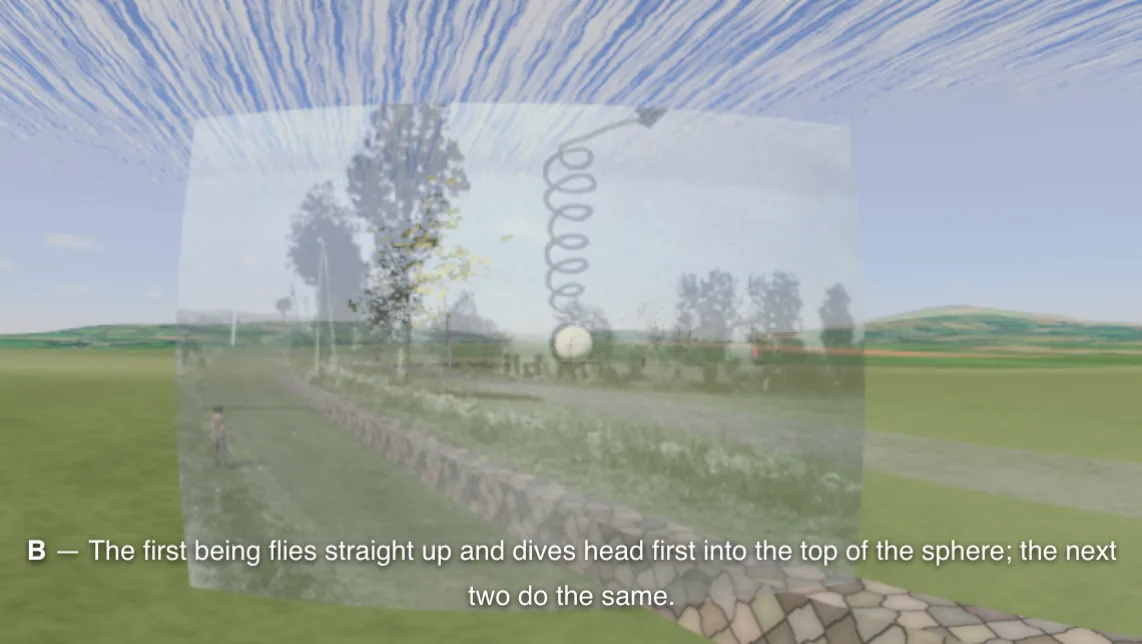
Everything above is computed, and a reader looking at the result has no way to tell a faithful reconstruction from a plausible one. A photograph of the same place does. A recording can carry pictures of where it happened — an observer's own, an investigator's, a magazine scan, a street-level capture — each laid over the render at an opacity the reader slides between all picture and all render, with the phenomenon drawn over both. Every tree the thirty-metre relief smoothed away, every ridge, the actual hedge, is then one picture with the reconstruction. Cussac carries its first: the 1968 view from the spot with the sphere and its climb drawn on by hand. With several pictures, the button opens a list above it, where each one is shown or hidden and faded on its own: McMinnville lays two prints over the same scene.
A picture is a field of directions from one point, and it is lined up as one: heading, pitch, roll and the lens's field, angles and nothing else. It stands in the three-dimensional scene as a flat panel at that field — which is what a lens makes — and is drawn through whatever the instrument declares, so the same picture is right under an eye's equidistant view and under a 50 mm's rectilinear one, and stays put when the reader turns. Nothing in the scene hides it and it hides nothing.
Lining it up is a measurement, not a feeling. Name a landmark on the picture and the same one in the render — a church tower, the end of a hedge, the horizon under a tree — and two of them turn the picture to fit; three or more fit its field too. The residual says how well it fits, landmark by landmark, in green, orange or red: one that will not go below a degree is telling you the picture was not taken from that spot, or that the relief is wrong there. And a picture that fits gives back the heading the observer actually faced — adopted into their pose with its provenance written down, where a heading typed in was only their word. Street-level pictures taken nearby (Panoramax, open imagery) arrive already lined up in heading, a full turn arriving as a panorama.
Every source is named where its data is reported, with the attribution its licence requires — and can be swapped for another. The picker is the credit. What is still missing, and what each item is waiting on, is on the roadmap.