 UFO
The sky
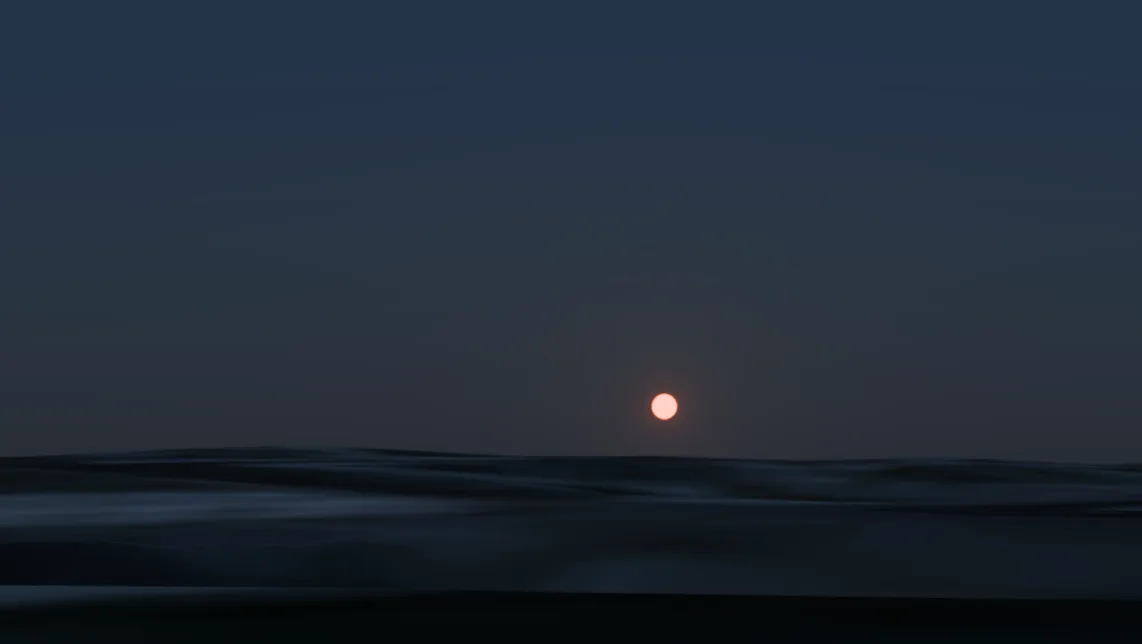
Sun, Moon and its phase, the planets and the stars are placed by ephemeris for that instant, that latitude and that longitude. Nothing is a picture of a sky: point at any of it and it names itself — “Venus, mag −4, 8° above the horizon”.
What is drawn from the catalogue stops at magnitude 6.5, and that number is a fact about a observer rather than about the sky: it is how faint a dark-adapted human eye goes. Put something else in front of the same night and the threshold moves with it — see the instrument.
The catalogue follows the same threshold. A naked-eye sky costs 400 kB, down to magnitude 7.5; 57 688 more stars, down to magnitude 9, are fetched only by a recording whose own optics reach that far. Past magnitude 9 it is the data that stops, and the tool reports the limit rather than drawing a sky emptier than the photograph held.
The catalogue is written for the year 2000, and the axis the sky turns about has moved since. Every star is carried to the date of the observation: a degree in 1918, fourteen in 1006, which is the difference between two constellations.
The Milky Way and the zodiacal light are integrated along the line of sight rather than painted as a texture — which is why they move correctly with the season, the hour and the observer's latitude instead of merely being in the right place once.
Every source is named where its data is reported, with the attribution its licence requires — and can be swapped for another. The picker is the credit. What is still missing, and what each item is waiting on, is on the roadmap.