 UFO
The light of the sky
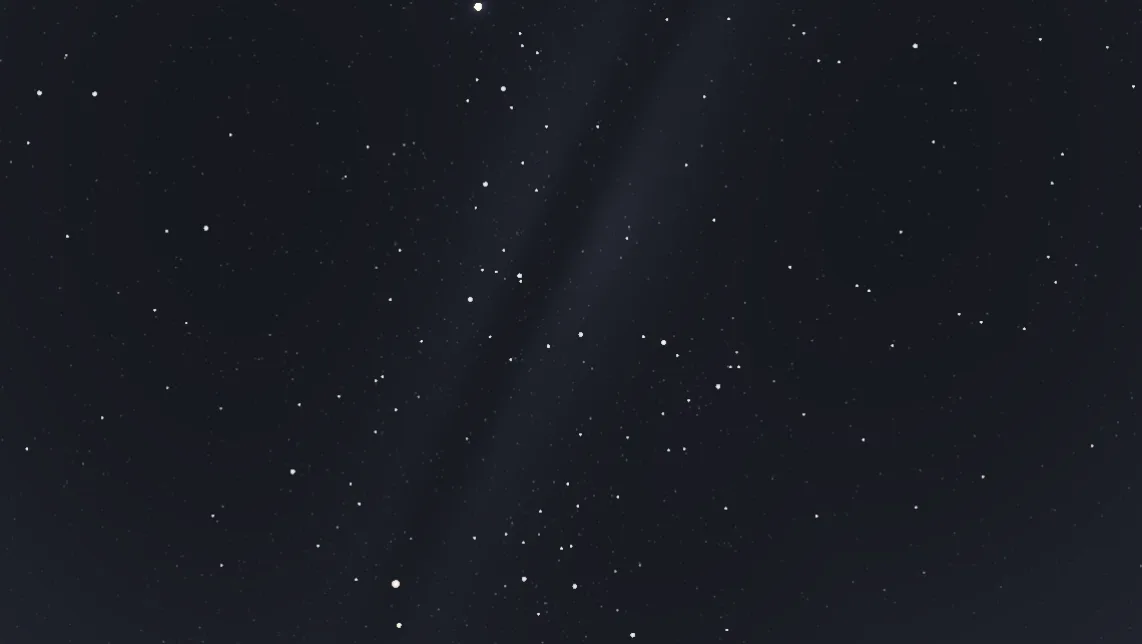
The sky itself is not a colour gradient. Sunlight and moonlight are traced through a spherical atmosphere at fifteen wavelengths across what an eye sees, the way light really reaches an observer: scattered once by the air on its way, then again and again, dimmed by what stands in front of it. Three things make up that air. The molecules of the air itself, which scatter blue far more than red and make the sky blue. The haze, which whitens the horizon and puts a bright aureole around the Sun, and which is thicker on a humid day than a dry one: its amount follows the relative humidity of the weather record. And the ozone layer, which absorbs a little orange, invisible at noon and the whole reason a twilight zenith is deep blue rather than a greyish yellow.
Everything a clear sky does then follows without being painted: the reddening and the brighter band along the horizon at sunset, the Earth's shadow rising opposite the Sun with the pink band above it, the slow darkening of twilight toward the east first, the deeper blue seen from an aircraft, the thinner air above a high site, and the moonlit sky, which is the same scattering of a far fainter source. The airglow of the upper atmosphere stays as the floor of every moonless night, brighter near the horizon where a line of sight crosses more of its layer.
The model is checked rather than trusted. A slow Monte Carlo trace of the same atmosphere, with no approximation but noise, puts the sky the scene draws within a quarter of a magnitude and a hundredth in colour from a hazy noon to a Sun sixteen degrees down, from the ground and from an aircraft. One place is known to be too dark, by two thirds of a magnitude: the Earth's shadow low in the sky during nautical twilight. And the zenith meets the twilight photometry measured at the Paranal observatory to within half a magnitude, without ever having been fitted to it.
What reaches the screen is what an eye adapted to that sky makes of it: a night sky is not ten million times darker than a day sky to an observer standing in it, and colour gives way to a dim blue-grey as the rods take over from the cones. A camera does none of this, so a recording made through one keeps the blue a long exposure really shows. How bright a day and a moonless night are shown are the two choices in that chain, and they are stated as choices.
What it does not do: no light pollution, no volcanic haze, no refraction of the Sun below the horizon, and the clouds are drawn on their own rather than dimming the light of the sky around them. How much haze a given town put in the air is unknowable from a record of 1948; only how much the humidity swelled it is modelled. The sources, and the choices behind each of them, are listed under the air.
Every source is named where its data is reported, with the attribution its licence requires — and can be swapped for another. The picker is the credit. What is still missing, and what each item is waiting on, is on the roadmap.