 UFO
What else was up there
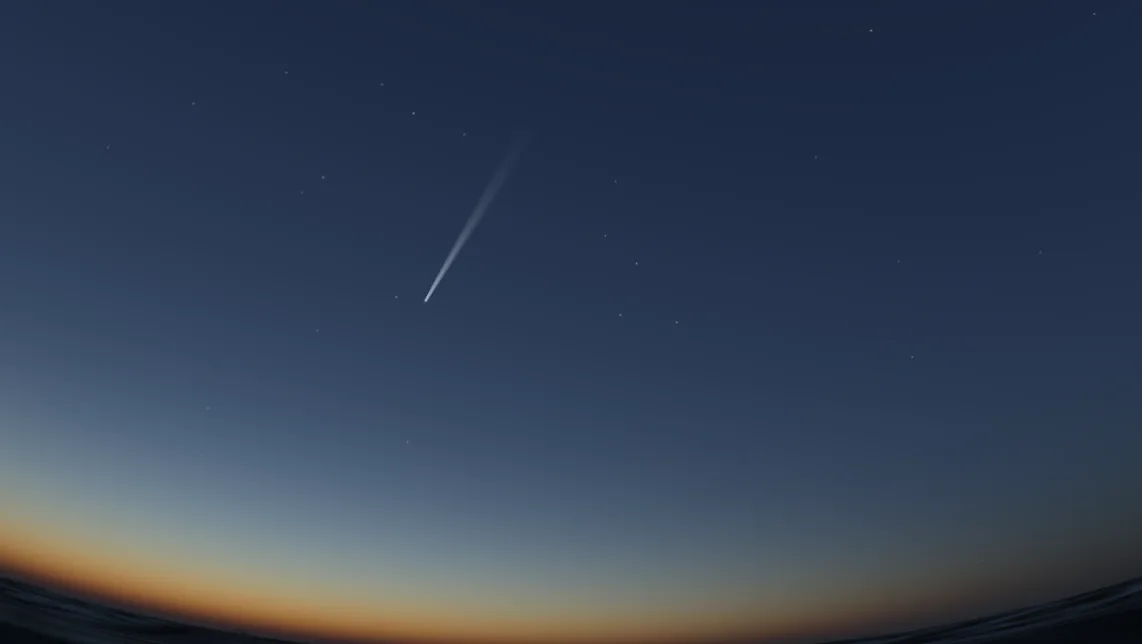
Each of these is a candidate explanation, so each must answer the same question before it is drawn: could it have been visible from there, then?
Comets appear at their own apparition and nowhere else. The catalogue is generated from JPL Horizons and the orbit is propagated, so a comet is either there on that date or it is not.
Novae and supernovae shine only on the nights their recorded light curve covers, and nowhere outside it: before the first record the star may already have been rising, and nobody can say how bright. Thirty-three eruptions reached the naked eye, from the supernova of 1006 to RS Ophiuchi in 2021. Their brightness is measured by the AAVSO for every nova up to 2006, reconstructed from Tycho's and Kepler's own comparisons for 1572 and 1604, and held to a few chronicled dates for 1054 and 1181; each one says which.
Eclipses are never declared. At every instant the Sun's and the Moon's positions as seen from the observer's own place, parallax included, say how much of the Sun's disc the Moon covers; the scene draws that crescent, the daylight it leaves, the corona when nothing is left, and the stars and planets the darker sky then allows, and for the second or two either side of totality the beads of light that the Moon's own relief lets through (NASA's LOLA map of its surface, with the libration of the day), and the orange ring round the whole horizon of lit air beyond the Moon's shadow. It is why 11 August 1999 is total at Reims and a mere 99 % at Paris. Seen bare-eyed, a crescent Sun is still a dazzling one: the shape shows through a filter, as it does for anyone who looks.
The Moon is drawn at the size it has that day: its orbit is an ellipse, so its disc is 0.56° across at perigee and 0.49° at apogee, the 14 % that “a supermoon” is made of. It is not larger on the horizon, where it is even a little farther: that impression is an illusion of the mind, which a camera does not share, and the scene does not copy it. What is true of a low Moon is its colour, which is the air's: the long path takes out its blue. That is all there is to the “lune rousse” of French lore, the full Moon of the lunation after Easter, which stands low because the Sun opposite it is already high.
Meteor showers come with their radiant and their hourly rate for that night, over the sporadic background that never stops.
Recorded fireballs are events, not rates: since December 2018 the Global Meteor Network's cameras have triangulated where each bright one began and ended and how bright it peaked, and a recording of that date draws every one that burned during it, from where the observer stood, as bright as its distance makes it.
Satellites get the harder question, because being lit is not the same as being seen: the Earth's shadow is computed for the date and hour to say whether one could have caught the Sun at all, and how many objects were in orbit on that date is known, and stated. Since February 2021 the tool goes further: the orbital elements saved once or twice a day by Laurent Chabin (SCEAU) give every satellite's real pass, lit through the Earth's shadow and as bright as it was measured to be, Starlink trains included. Before that date no individual pass is drawn, because none could be drawn truthfully.
Re-entries are placed by an interpretation, not found: a satellite or rocket stage breaking up into burning pieces, on a path somebody established (orbital elements are off by minutes in the last orbit). It is placed on the Earth, 70 to 100 km up, and seen through the Earth's curvature from where the observer stood, each piece as bright as its distance makes it, with its tail along its own path, until it has burned. It glows from its own heating, so the Earth's shadow does not put it out. Which re-entries could have been in a sky is stated from the record (CORDS since 2000, the satellite catalogue's decay days since 1957), each with its precision: a sighting on record near enough in time and place, a prediction whose window meets the observation, or a bare day. An orbit that never comes within sight of the observer's latitude is never listed.
Every source is named where its data is reported, with the attribution its licence requires — and can be swapped for another. The picker is the credit. What is still missing, and what each item is waiting on, is on the roadmap.